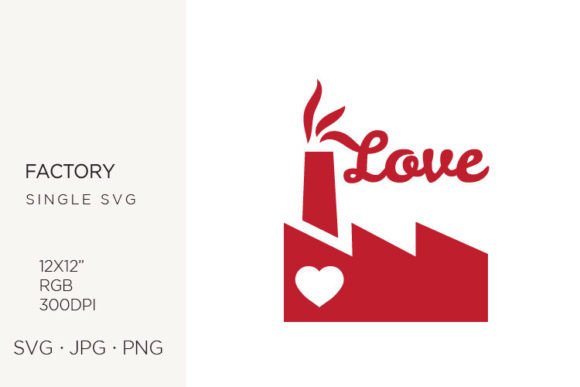
Integrating the Heart Inside Red Factory Illustration into Professional Creative Workflows
In the fast-paced environment of modern graphic design and digital content creation, the efficiency of your asset library often dictates the speed and quality of your output. Professionals ranging from freelance illustrators to small business owners understand that starting a project from a blank canvas is rarely the most strategic move. Instead, leveraging high-quality, pre-constructed vector elements allows creators to focus on customization and brand alignment rather than foundational drafting. The Heart Inside Red Factory Illustration serves as a prime example of such a versatile asset. This is not merely a static image; it is a functional component designed to fit seamlessly into diverse production pipelines, offering scalability and adaptability for projects requiring industrial themes mixed with emotional or community-focused messaging.
Understanding the technical specifications of this asset is the first step in effective integration. Created in Adobe Illustrator, the file exists as a true vector graphic. This distinction is critical for workflow planning. Unlike raster images that degrade when enlarged, this illustration maintains crisp lines and perfect geometry regardless of scale. With an artboard size of 12 x 12 inches and a resolution capability of 300 DPI in RGB color palette, the source file is optimized for both high-resolution print outputs and vibrant digital displays. The availability of multiple file formats—SVG, JPG, and PNG—ensures compatibility across virtually every software ecosystem, from web development environments to professional printing presses.
Strategic Placement in the Design Lifecycle
The utility of the Heart Inside Red Factory Illustration extends across various stages of a project lifecycle. In the planning and conceptualization phase, this graphic can serve as a mood board anchor. For marketers developing a campaign around manufacturing safety, corporate social responsibility, or "made with love" branding, this image immediately establishes a visual tone that balances industrial rigor with human care. Using the SVG format during this stage allows stakeholders to manipulate colors and layout proportions in real-time during presentation meetings, facilitating faster decision-making without waiting for revised drafts from the design team.
During the execution phase, the vector nature of the file becomes indispensable. Designers working on large-format wall art or trade show banners can scale the illustration to massive dimensions without worrying about pixelation. The clean paths inherent in Adobe Illustrator files mean that separating the heart element from the factory structure is a straightforward task if the project requires isolating specific components. This flexibility supports rapid iteration. If a client decides mid-project that the "heart" needs to be more prominent or the factory silhouette needs to match a specific brand color, the editable vector data allows for these changes to be made in minutes rather than hours.
Post-production and deployment also benefit from the diverse file formats provided. For web designers implementing responsive layouts, the SVG file ensures the graphic loads quickly and renders sharply on retina displays and mobile devices alike. Conversely, for social media managers needing quick turnaround times for posts, the pre-rendered PNG with transparency offers a drop-in solution that requires no additional processing. This duality reduces bottlenecks in the publishing workflow, allowing teams to maintain consistency across channels while adhering to tight deadlines.
Application Across Industries and Use Cases
The versatility of this digital graphic element allows it to transcend traditional boundaries, finding relevance in sectors as varied as education, event planning, and product manufacturing. For stationery and invitation designers, the illustration provides a unique thematic hook. Imagine a wedding invitation suite for a couple who met working in engineering or a corporate anniversary party for a manufacturing firm. The Heart Inside Red Factory motif bridges the gap between professional identity and personal celebration. When printed on high-quality cardstock using the 300 DPI source file, the result is a tactile, premium feel that elevates the perceived value of the event.
In the realm of handmade crafts and jewelry design, entrepreneurs can utilize the PNG or JPG exports to create transfer designs for ceramics, enamel pins, or laser-cut wooden ornaments. The clear definition of the vector lines ensures that when these images are converted into machine-readable formats for cutting plotters or laser engravers, the edges remain smooth and precise. This reliability is crucial for small business owners who cannot afford material waste due to poor file quality. Furthermore, the simplicity of the design makes it an excellent candidate for screen printing on apparel, where limited color palettes and bold shapes are often preferred for cost-efficiency and visual impact.
Educators and publishers can also leverage this asset to create engaging learning materials. Whether illustrating a storybook about community helpers or designing a worksheet about local industries, the friendly yet structured aesthetic of the heart within the factory captures attention without being overly complex. The ability to recolor the RGB palette allows educators to match school branding or differentiate materials for various grade levels. By integrating such professional assets into curriculum design, educators save time on illustration tasks and can devote more energy to pedagogical strategies and lesson planning.
Technical Integration and Workflow Optimization
To maximize the return on investment from digital assets like the Heart Inside Red Factory Illustration, organization and file management are paramount. A streamlined workflow begins with proper ingestion of the files into your asset management system. It is advisable to maintain the original Adobe Illustrator (.AI) file as the master copy, stored in a version-controlled repository. From this master, derivatives in SVG, JPG, and PNG should be generated and categorized by intended use case (e.g., "Web," "Print," "Social"). This hierarchy ensures that if a global change is needed later, you always have the editable source to revert to.
Compatibility with other tools is another factor to consider. While the primary creation tool is Adobe Illustrator, the SVG format ensures interoperability with open-source alternatives like Inkscape or web-based tools like Figma and Canva. This cross-platform compatibility is vital for collaborative teams where not every member may have access to the full Adobe Creative Cloud suite. By standardizing on the SVG format for collaborative editing, teams can ensure that layer structures and path data remain intact, preventing the "flattening" issues that often occur when exchanging rasterized JPEGs back and forth.
Quality control processes should also account for the specific attributes of vector graphics. Before finalizing any print job, always verify that the RGB color values translate accurately to the CMYK space if the final output is offset printing. While the source file is optimized for RGB (ideal for screens and some digital printers), converting to CMYK early in the process allows you to adjust the red tones of the factory and heart to prevent dullness or color shifting. Additionally, check the stroke weights and tiny details in the factory illustration to ensure they do not fall below the minimum printable line thickness for your chosen paper stock.
Long-Term Value and Brand Consistency
Investing in high-quality vector illustrations yields long-term dividends for brand consistency. As your business or creative portfolio grows, having a library of cohesive, scalable assets ensures that your visual language remains stable across different mediums. The Heart Inside Red Factory Illustration can become a recurring motif in your branding ecosystem. Perhaps it starts as a logo element, evolves into a pattern for packaging, and eventually becomes an icon in your mobile application interface. Because the file is vector-based, this evolution happens without the need to recreate the asset from scratch, preserving the integrity of the original design intent.
Furthermore, the timeless nature of simple, geometric vector art protects your work from trending obsolescence. Unlike highly textured or photorealistic styles that may date quickly, the clean lines of this illustration offer a modern, flat-design aesthetic that aligns with current UI/UX trends while remaining legible and effective for years to come. This longevity reduces the frequency of rebranding cycles, saving both time and financial resources in the long run.
Ultimately, the successful integration of the Heart Inside Red Factory Illustration into your workflow depends on viewing it not just as an image, but as a flexible tool. By understanding its technical strengths, organizing it effectively within your digital asset management system, and applying it strategically across print, web, and physical products, you enhance your operational efficiency. Whether you are crafting a single handmade card or deploying a multi-channel marketing campaign, this vector asset provides the structural foundation needed to execute your vision with precision and professionalism.